The Mathematical Imagination
Seeing the world quantitatively

The origins of the natural numbers 1, 2, 3, 4, 5, 6, … are lost in the mists of time. We have no knowledge of who first realized that there is a certain concept of “threeness” that applies equally well to three rocks, three stars, and three people. From the very beginning, numbers hav inspired an endless fascination—mystical, aesthetic, but practical as well.
— Joseph H. Silverman
In 1959, the sociologist C. H. Mills wrote The Sociological Imagination, which described a deep way to understand how our individual lives are shaped by the world around us.
In 2025, a twitter post went viral with a visual mockup of “how a mathematician sees the world” complete with .
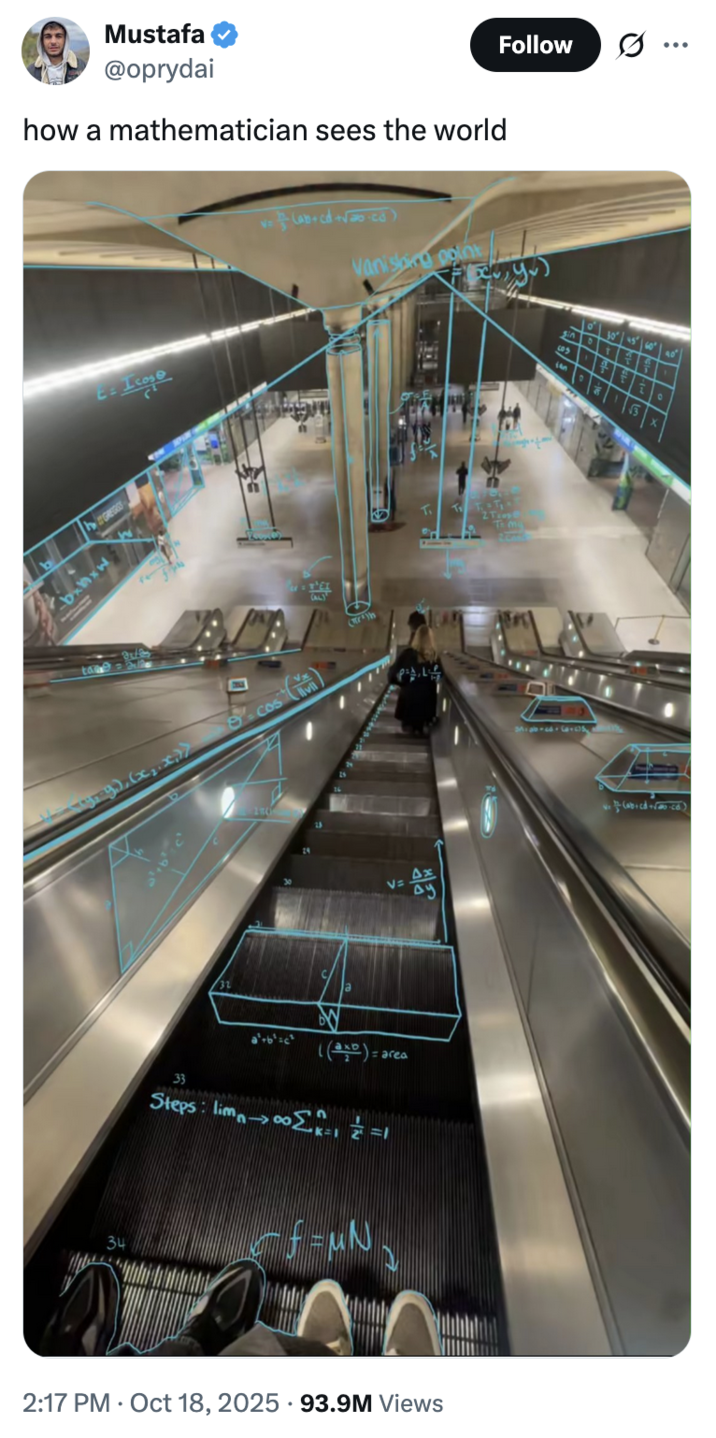
That twitter post has been rightly mocked, but it’s only a partial exaggeration.
an enormous number of problems can be understood and solved easily through a quantitative lens.
Several of my friends in my major said that there came a point during multivariable calculus or linear algebra courses where they began to understand the world as a 3-dimensional coordinate grid.
But that is only one component of what I would call the mathematical imagination.
Eugene Wigner wrote a now-famous essay about what he called the unreasonable effectiveness of mathematics.
“the enormous usefulness of mathematics in the natural sciences is something bordering on the mysterious and that there is no rational explanation for it.”
The fact that I can sit down and scribble some symbols on a piece of paper and discover something about the trajectories of stars or animal populations or stock markets – not just in specific cases, either. These relationships describe all planetary trajectories, all ecosystems, and all stocks; the relationship exist independent of any specific inputs and outputs.
In each of these three cases, the mathematics that we use was in some part developed or inspired by the phenomena that they explain; we also can’t make real predictions without plugging in numbers that come from observed data. But there are many cases where seemingly useless mathematics has been discovered to have incredible utility.
G. H. Hardy wrote his 1940 essay A Mathematician’s Apology
Only several decades later was it discovered that number theory, the field that Hardy worked in and was “apologizing” for, was deeply useful. Perhaps the essay’s most ironic quote:
No one has yet discovered any warlike purpose to be served by the theory of numbers or relativity, and it seems unlikely that anyone will do so for many years.
Even as Hardy wrote these words, Alan Turing and his team at Bletchley Park were using number theory to crack German Enigma codes, which may have hastened the defeat of Nazi Germany by as much as two years. Since then, RSA and elliptic-curve cryptography have become the backbone for the information economy and international espionage.
As for relativity, the world famous equation $e = mc^2$ relating mass and energy gave J. Robert Oppenheimer and Trinity the nuclear bomb. The twin desolations of Hiroshima and Nagasaki just 5 years after Hardy penned his essay marked the end of the second world war and the beginning of the atomic age that has haunted the world ever since.
Hardy is, of course, correct that mathematics and knowledge in general ought to be pursued for its own sake rather than for only practical purposes. But the point is that mathematics is so far-reaching and multifaceted that even its foremost experts cannot tell the difference.
Even mathematics that
It’s no wonder that mathematics has been adjacent to religion in so many cultures around the world.
which computational world we live in
So the question stands—a question that strikes me as obviously important, even though as far as I know, only one or two people ever asked the question before us… Namely: do the axioms of set theory suffice to analyze the behavior of every computer program that’s at most, let’s say, 50 machine instructions long? Or are there super-short programs that already exhibit “Gödelian behavior”?
Theoretical computer scientists might object that this is “merely a question of constants.” Well yes, OK, but the origin of life in our universe—a not entirely unrelated puzzle—is also “merely a question of constants”! In more detail, we know that it’s possible with our laws of physics to build a self-replicating machine: say, DNA or RNA and their associated paraphernalia. We also know that tiny molecules like H~2~O and CO~2~ are not self-replicating. But we don’t know how small the smallest self-replicating molecule can be—and that’s an issue that influences whether we should expect to find ourselves alone in the universe or find it teeming with life.
The mathematical imagination is this ability to connect seemingly niche academic questions to behavior in the world around us.
that we might see as so fundamental that we hardly even notice it.
If I flip a fair coin over and over again, then the numbers of heads and tails will average out. I can just observe that this is true without needing to know anything about the law of large numbers or almost sure convergence. What mathematics reveals is that the likelihood that the number of heads and tails fail to average out is roughly the same likelihood that the sun will fail to rise tomorrow.