A Roadmap to Self-Study Math

Preface
…Mathematics may be defined as the subject in which we never know what we are talking about, nor whether what we are saying is true.
— Bertrand Russell
Math is an incredibly rewarding subject; although it can be frustrating and austere, it rewires your brain in a way that makes it very easy to break down large, difficult problems into simpler pieces. It’s an extremely powerful lens through which to view the world.
If you struggled with math (or even hated it!) while you were forced to study it in public school, you’re not alone. I personally hated math until I was lucky enough to learn from two amazing calculus teachers after I had fallen behind in precalculus; I found myself asking questions about math more and more in my free time, and eventually decided to study mathematics at Mass Bay Community College and Northeastern University, where I got my bachelor’s and master’s degrees in math. I discovered that the state of math education around the world, but particularly in the United States, is something of a crisis, largely because of a lack of funding, outdated curricula, and perhaps a lack of support for children with math-related learning disabilities.
Most study tracks in the United States go something like arithmetic (from kindergarten to middle school), algebra (from middle school to early high school), and then trigonometry, pre-calculus, and calculus in highschool. This track was mostly developed to put American children on the fast track to differential equations, a field of math that is accessible right after calculus, and could be used by rocket scientists to beat the Soviets to the moon. Even though Neil Armstrong walked on the moon over a half-century ago, the US math curriculum has not been seriously overhauled since.
But here’s the good news: you have the freedom to pursue math in exactly the subject areas and at the rate that works for you, without any interference from whatever board of education out there that’s to ruin math’s reputation. If you do want a good introduction to algebra, Khan Academy has earned its reputation for great lessons. The subject is far, far more varied than algebra and calculus, and the teachers will (hopefully!) be much more enthusiastic.
Before you continue, I want to offer some scattered pieces of advice:
- The image of mathematicians as students with an aptitude for math from the womb is a complete myth. The most talented people in my cohort didn’t enter college expecting to study math;
- Math can be confusing and frustrating. I’ve gotten totally lost or very annoyed at many times during my degree. You’re not supposed to recognize the solution to every problem immediately: being confused or stuck is just what it feels like to brush up against the edge of what you know. That’s also what makes the breakthroughs so satisfying.
- Math is not just something you read about; it’s something you do. Please do your best to attempt at least a couple exercises, and stick with them even if you get stuck.
- Math is a collaborative subject; the (arguably) world’s leading mathematician, Terence Tao, is so highly regarded and successful in large part because he works with such a huge variety of collaborators. If you can find a study group or community of fellow learners, you’re going to have a much smoother experience.
Finally, there’s some fun pop-math at the end of the article that you will hopefully enjoy, and the philosophy of math is something that anyone who interacts with the subject will inevitably be drawn to.
And, therefore, we must not despise the science of numbers, which, in many passages of holy Scripture, is found to be of eminent service to the careful interpreter.
— Saint Augustine, The City of God
The Essentials
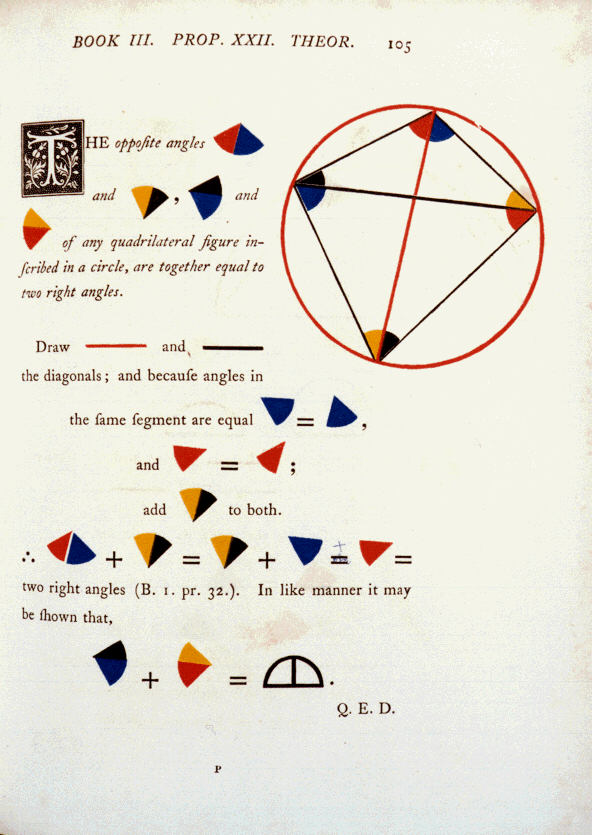 A page from Oliver Byrne’s edition of The Elements of Euclid. Oliver Byrne, Public domain, via Wikimedia Commons
Euclid alone has looked on Beauty bare.
— Edna St. Vincent Millay
The core of math lies in proofs. A mathematical proof is a sequence of steps starting from some assumptions (called axioms or hypotheses) and proceeding to a conclusion. These conclusions are often called theorems. Math is unique in that this reasoning can be expected to be more or less “airtight”: a the theorems that emerge from a correct proof aren’t only true sometimes, they are unambiguously and always true whenever the assumptions hold.
Proofs are most often introduced in a freshman-level class which introduces a family of mathematical subjects collectively called “discrete math”. The two most basic units for this field are boolean logic, the framework that we use to construct and judge proofs and logical arguments, and set theory, which is the bedrock on which basically all of math is constructed.
The rest of the discrete math umbrella is built on these subjects, and includes:
- Graphs
- Combinatorics (permutations and combinations)
- Modular arithmetic
- Group theory
None of these subjects, logic and sets included, require anything beyond basic algebra skills. Through these subjects, you should become acquainted with basic proof techniques like induction and contradiction. You absolutely don’t need to master all of these topics, but a strong foundation and a rough feel for each of these subjects will be a huge benefit for studying almost any other area of math.
To get started, I recommend Discrete Mathematics: An Open Introduction by Oscar Levin or Book of Proof by Richard Hammack. If you want to try something interactive, the natural number game is an introduction to proofs using Microsoft’s proof assistant, Lean, which helps to break down proofs step by step in a super organized way. Alternatively, if you have a strong grasp of algebra and are primarily interested in studying a proof-based introduction to calculus, the Terence Tao’s Analysis 1 provides that and an interesting discussion on the foundations of mathematics.
Linear Algebra
 A diagram of a neural network. QuantuMechaniX8, CC0, via Wikimedia Commons
Unfortunately, no one can be told what the Matrix is. You have to see it for yourself.
— Morpheus, The Matrix
After you have a solid foundation in discrete math, I heavily recommend studying linear algebra, which is an essential backbone in virtually every area of math. Linear Algebra Done Right by Sheldon Axler lives up to its name. Most university linear algebra courses are taught with engineers in mind, so the intuitive explanations take a back seat to more applied topics. Axler’s book takes a more “high brow” view of the subject, and gives a far more intuitive approach from first principles. Any linear algebra class should be supplemented with 3blue1brown’s linear algebra series, which helps to visualize difficult concepts like linear transformations (as actual transformations!) and span. Linear algebra has a steep learning curve, but a lot of the challenge is just peeling back the rigorous, abstract definitions and finding the deeply intuitive concepts underneath. You’ll then be equipped to understand his videos on machine learning.
For the more applied parts of linear algebra, I would recommend Gilbert Strang’s Linear Algebra textbook for referencing.
Abstract Algebra
A Rubik’s cube is an example of a group
Be wise! Generalize!
— Picayune Sentinel
The meatiest branch of math, and the one I consider to be a kind of backbone for the entire subject, is abstract algebra (or just “algebra” to mathematicians). Abstract algebra essentially abstracts over many patterns that appear all over mathematics: for example, we can add, subtract, and multiply matrices, just like we can add, subtract, or multiply integers; that’s because matrices and integers are both examples of a structure called a ring. I often think of abstract algebra as the backbone of math; there are three major subjects you’ll encounter in a standard abstract algebra class:
- Group theory, which is the mathematical study of symmetry and provides the foundation for virtually all of modern mathematics and has major applications in physics, chemistry, cryptography, and many other areas. Here’s an excellent video to motivate the subject.
- Ring theory, which generalize the notion of “numbers” to anything that has operations that behave like addition, subtraction, and multiplication. If you study number theory, you may see that a lot of the proofs from number theory can be generalized to rings. They can also be used to generalize vector spaces to a broader class of object called modules.
- Field theory, which we often think of as a special kind of ring that has addition, subtraction, multiplication, and division. Fields also have a deep relationship with vector spaces. (In fact, fields are vector spaces.)
For motivation and a basic overview, I started with Socratica’s abstract algebra playlist. For a proper discussion of the subject, I’d recommend reading the through Algebra: Chapter 0 by Aluffi. Many people enjoy the book’s tone, and it teaches algebra in a much more “modern” way than some of the standard texts (like Dummit \& Foote). Aluffi introduces abstract algebra from the perspective of category theory, which helps organize the subject more neatly. There’s also Algebra by Michael Artin, which provides a delightfully offbeat view of the subject with applications to geometry.
Fun facts: Michael Artin’s father is none other than the legendary algebraic number theorist Emil Artin. I am also told Michael would occasionally show up to give his MIT lectures in a gorilla suit:
These qualities are illustrated in the gorilla suit stories. On his 40th birthday his wife, Jean, gave Mike a gift he had wanted, a gorilla suit. In experiments with the pets of family and friends, he found his wearing it did not disturb cats, but made dogs extremely agitated. Testing this theory on after-dinner walks, he found dogs crossed the street to avoid him. Experimenting once, Mike had gone ahead of his wife and friends to hide in a neighbour’s bushes when a squad car stopped. As an officer got out of the car, Jean called out “He’s with me.” After a closer look the officer turned back, telling his buddy “It’s OK - just a guy in a gorilla suit.”
Once Mike wore the suit to class and, saying nothing, slowly and meticulously drew a very good likeness of a banana on the board. He then turned to the class, expecting some expression of appreciation, perhaps even applause, for a gorilla with such artistic talent, but was met with stunned silence.
Graph Theory
 A visualization of a computer network as a graph. Savionasc, CC BY-SA 4.0 https://creativecommons.org/licenses/by-sa/4.0, via Wikimedia Commons
Graph theory is the branch of math that studies graphs. (Which are also called, more accurately, “networks” – they’re totally different from the graphs you study in highschool algebra!) You can think of graphs essentially as flow charts: there are “nodes” or “vertices” (that correspond to the boxes or circles with text in them) which are connected by lines called “edges” (which might correspond to arrows).
Graph theory is probably one of the most practically useful subjects. Maybe you want to schedule tasks efficiently, find the most efficient route from one place to another, or solve puzzles like “who is the liar”. In fact, graph theory was invented to solve an 18th century riddle asking if it was possible to find a path through the city of Königsberg that crosses each bridge exactly once.
Richard J. Trudeau’s Graph Theory book is one of the standard texts, and reads quite nicely. Deistel’s Graph Theory is a faster, more comprehensive introduction with less focus on applications.
Intermediate Topics
Number Theory
 3-adic integers with dual colorings. Melchoir, CC BY-SA 3.0 https://creativecommons.org/licenses/by-sa/3.0, via Wikimedia Commons
The origins of the natural numbers 1, 2, 3, 4, 5, 6, … are lost in the mists of time. We have no knowledge of who first realized that there is a certain concept of “threeness” that applies equally well to three rocks, three stars, and three people. From the very beginning, numbers hav inspired an endless fascination—mystical, aesthetic, but practical as well.
— Joseph H. Silverman
At this point, there are several avenues open to you. If you liked group theory and some of the early topics from Beachy and Blair, I recommend pursuing number theory, which is the enormous field studying patterns in the integers. A Friendly Introduction to Number Theory by Joseph H. Silverman is a wide introduction and an excellent place to start; if you want a more advanced introduction to the subject (or a second course), A Classical Introduction to Modern Number Theory by Ireland and Rosen is a good choice.
My undergraduate capstone project on elliptic curves drew heavily from Rational Points on Elliptic Curves by Joseph H. Silverman and John T. Tate. Elliptic curves are fascinating objects that have a central place in modern mathematics, and were used to settle Fermat’s Last Theorem, which was math’s biggest unanswered problem for over 350 years until it was solved with elliptic curves. The Birch and Swinnerton-Dyer Conjecture is an open problem about elliptic curves; as a Millennium prize problem, solving it would net a $1,000,000 prize.
Theoretical Computer Science
 A page from the Principia Mathematica. Whitehead and Russell, Public domain, via Wikimedia Commons
Computer science is no more about computers than astronomy is about telescopes.
— Edsger Dijkstra
With a crash course in proofs, set theory, and graph theory, you can jump into Introduction to the Theory of Computation by Michael Sipser, which is an excellent read. I recommend that you do exercise 28 in chapter 5, which covers Rice’s Theorem, a very useful theorem in theoretical computer science. (I’m honestly surprised Sipser put such little emphasis on it!) The Annotated Turing by Charles Petzold is also a really cool modern dissection of Alan Turing’s revolutionary 1937 paper On computable numbers, with an application to the Entscheidungsproblem, which is considered the founding text of computer science.
I also recommend reading Scott Aaronson’s excellent blog Shtetl-Optimized, particularly Five Worlds of AI, the 8000th Busy Beaver number eludes ZF set theory, and Logicians on safari.
Calculus
 A Riemann sum converges to the area under the curve. Brad219, CC0, via Wikimedia Commons
The infinite! No other question has ever moved so profoundly the spirit of man.
— David Hilbert
Calculus is the star of every ambitious highschooler’s senior year, and is the reason that I became a mathematician. It is the study of change, specifically “instantaneous change”. It has applications virtually everywhere: business, engineering, physics, computer science (particularly machine learning), biology, statistics, and everywhere else. You’re best served by picking up a copy of Calculus: Early Transcendentals by James Stewart and supporting it 3blue1brown’s calculus series; if you’re a bit ambitious and want to see some of the nitty-gritty details that often get swept under the rug, consider adding on Calculus by Spivak. When you get to multivariable calculus, add on Khan Academy’s lecture series. (You might recognize the narrator.)
Real Analysis
 The 6th iteration of the hexa-Gosper curve, an example of a space-filling curve. NightElfik, Public domain, via Wikimedia Commons
God made the integers, all else is the work of man.
— Leopold Kronecker
Calculus is a treat, but eventually the time comes for every mathematician to discover out how the sausage is made. You may have noticed that the calculus textbooks were very light on proofs. (This is because most calculus students are physicists or engineers; the most important part of being a mathematician is learning to hate those “people”.) Unfortunately, the subject can’t meaningfully advance until you build up a real, rigorous foundation for the calculus on the real numbers: this field is called real analysis, and my two preferred books on the subject are Analysis I by Terence Tao and Understanding Analysis by Stephen Abbott. After you’re done with those and want to study calculus in a more general setting, the standard text is Calculus on Manifolds by Spivak.
Topology
 This 3D model of a cow is homeomorphic to a sphere. Keenan Crane; GIF by username:Nepluno, CC BY-SA 4.0 https://creativecommons.org/licenses/by-sa/4.0, via Wikimedia Commons
In these days the angel of topology and the devil of abstract algebra fight for the soul of every individual discipline of mathematics.
— Hermann Weyl
After the beauty of calculus has been thoroughly shredded by real analysis, you can either learning some machinery to abstract over and simplify the heinously ugly proofs of important theorems (such as the intermediate value theorem). Abbott’s book points towards the subject of topology, which is the abstract study of space and continuity, which has applications all over physics and advanced math. Introduction to Topological Manifolds by John Lee is a nice read; Topology by Munkres is the standard text in the field; it’s a bit terse but worth referring to as a secondary text.
Complex Analysis
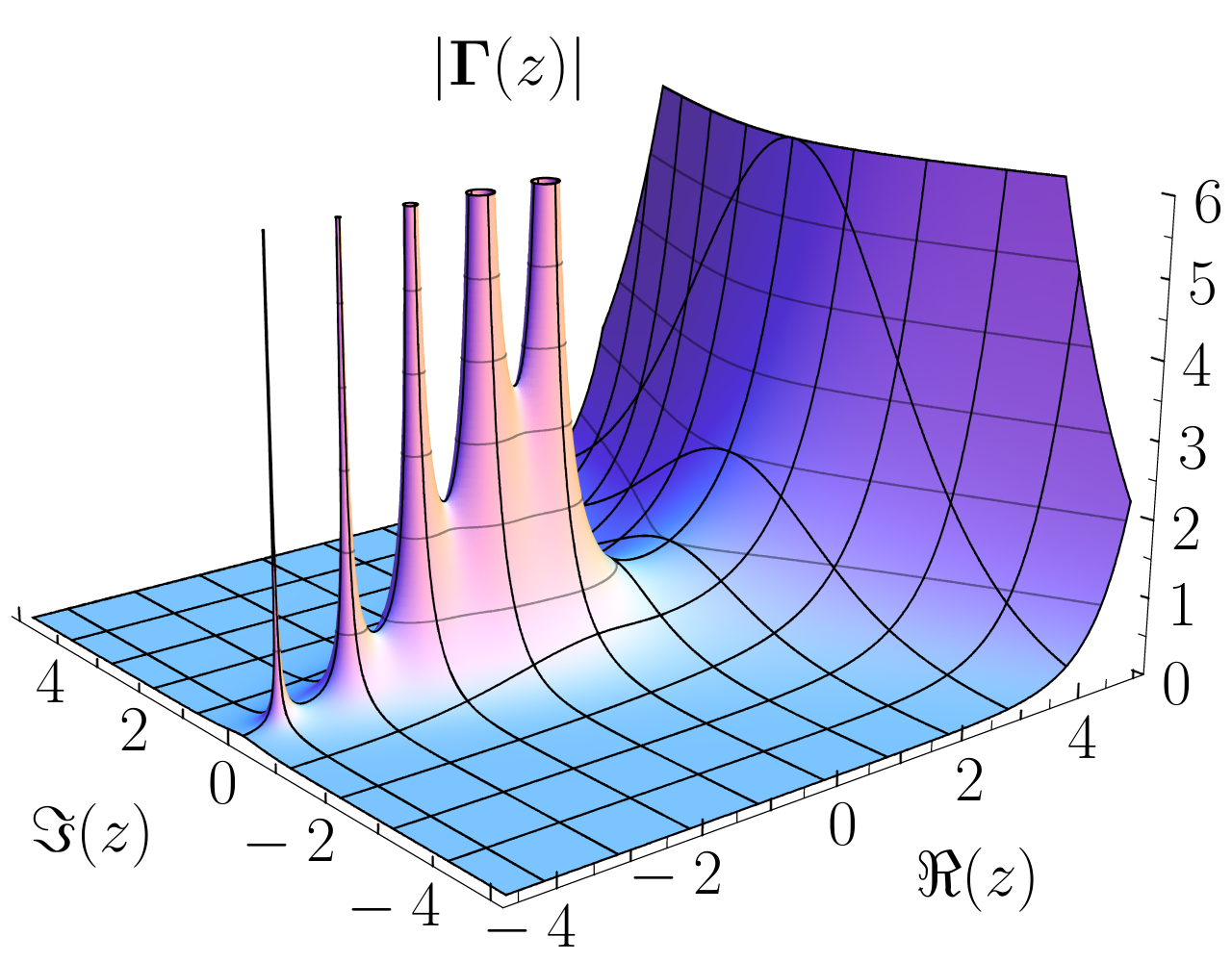 A visualization of the absolute value of the gamma function. Geek3, CC BY-SA 3.0 https://creativecommons.org/licenses/by-sa/3.0, via Wikimedia Commons
…Entre deux vérités du domaine réel, le chemin le plus facile et le plus court passe bien souvent par le domaine complexe.
[…The easiest and shortest path between two truths in the real domain passes very often through the complex domain.]
— Jacques Hadamard
If you find yourself pining for the days before real analysis where you could be forgiven for believing fairy tales like “every continuous function is differentiable” and “every differentiable function is infinitely differentiable and converges to its Taylor series”, consider studying complex analysis, where those statements are actually true. Complex analysis the extension of calculus to functions of a complex variable, and is often considered the most beautiful field of math. Complex analysis has applications in physics, engineering, and elsewhere. You can get a visual understanding from Visual Complex Analysis by Needham; for a more standard introduction, I’ve heard good things about Complex Analysis by Stein and Shakarchi.
Differential Equations
 The path traced by a double-pendulum forms a chaotic system. Cristian V., CC BY-SA 4.0 https://creativecommons.org/licenses/by-sa/4.0, via Wikimedia Commons
A natural next step after learning calculus is solving differential equations; I recommend learning about separable ordinary differential equations, the Laplace transform, the eigenvalue method, and the Fourier transform. The theory of differential equations is actually something I know very little about, so I can’t make any solid recommendations there.
Probability
All knowledge degenerates into probability.
— David Hume
Now that you’ve learned calculus, it’s a good time to jump into probability and statistics, which are used literally everywhere. My textbook was An Introduction to Mathematical Statistics and its Applications by Larsen and Marx, which only uses calculus.
The probability book with the real meat is Probability Theory with Examples by Durrett, which teaches probability using measure theory, which is a much more powerful foundation and really gets to the core of probability. Durrett gives a crash course on measure theory and hits all the major topics in probability theory, but is a bit terse.
The Hard Stuff
Galois Theory
This letter, if judged by the novelty and profundity of ideas it contains, is perhaps the most substantial piece of writing in the whole literature of mankind.
— Hermann Weyl
The crowning theorem of an introductory abstract algebra sequence is Abel-Ruffini and Galois theory. Galois theory, like complex analysis, is renowned for its beauty and power. The motivating question for Galois theory is determining why quadratic, cubic, and quartic polynomial all have explicit formulas for their roots, but the general quintic polynomial doesn’t. The answer – the Abel-Ruffini theorem – just kind of tumbles out at the end of the course, and by then you won’t even care: it pales in comparison to the fundamental theorem of Galois theory and the Galois correspondence. This is one of the final topics in Aluffi, so just keep reading and you’ll get a solid overview.
Category Theory
The further a mathematical theory is developed, the more harmoniously and uniformly does its construction proceed, and unsuspected relations are disclosed between hitherto separated branches of the science.
— David Hilbert
After seeing the isomorphism theorems proven multiple times and seeing the fundamental theorem of Galois theory, I recommend reading Category Theory In Context by Emily Riehl to get “a bird’s eye view of math”.
Algebraic Geometry
L’algebre n’est qu’une géométrie écrite; la géométrie n’est qu’une algébra figurée.
[Algebra is merely geometry written; geometry is merely algebra visualized.]
— Sophie Germain
If you’ve gotten this far and still want more, look at the most recent version of The Rising Sea by Ravi Vakil and start sending out PhD applications.
Philosophy of Math
 The interior side of the dome of the Sheikh Lotf-Allah mosque in Isfahan, Iran. Phillip Maiwald (Nikopol), CC BY-SA 3.0 https://creativecommons.org/licenses/by-sa/3.0, via Wikimedia Commons
Math is fairly mysterious, even to experts. Why is mathematics so good at solving problems across such a wide variety of domains? In particular, why is it such a useful tool for the natural sciences like physics, biology, chemistry, and so on? One famous essay raises this question:
There is a story about two friends, who were classmates in high school, talking about their jobs. One of them became a statistician and was working on population trends. He showed a reprint to his former classmate. The reprint started, as usual, with the Gaussian distribution and the statistician explained to his former classmate the meaning of the symbols for the actual population, for the average population, and so on. His classmate was a bit incredulous and was not quite sure whether the statistician was pulling his leg. “How can you know that?” was his query. “And what is this symbol here?” “Oh,” said the statistician, “this is pi.” “What is that?” “The ratio of the circumference of the circle to its diameter.” “Well, now you are pushing your joke too far,” said the classmate, “surely the population has nothing to do with the circumference of the circle.” Naturally, we are inclined to smile about the simplicity of the classmate’s approach. Nevertheless, when I heard this story, I had to admit to an eerie feeling because, surely, the reaction of the classmate betrayed only plain common sense.
These are the opening paragraphs to The Unreasonable Effectiveness of Mathematics in the Natural Sciences by Eugene Wigner, and is expanded on in a follow up The Unreasonable Effectiveness of Mathematics by R. W. Hamming. (The guy who made Hamming codes.)
The philosophy of math stretches all the way back to Plato, and there are a handful of books an articles worth reading to understand the history and debates of the philosophy of math:
- Here’s the Stanford Encyclopedia of Philosophy entry on The Philosophy of Math
- Philosophy of Mathematics: Selected Readings, edited by Paul Benacerraf and Hilary Putnam
Pop Math
- For high-quality and accessible videos about math, I recommend 3blue1brown (especially the hardest problem on the hardest test) and some of Veritasium’s videos, as well as this playlist of riddles by TED-Ed.
Numberphile has some good videos too, with the exception of their -1/12 video, which is a real stinker that they’ve made many follow up videos on. Here’s one video discussing it, and another here for an explanation of the Riemann zeta function and analytic continuation.
The only Millenium Problem to be solved, The Poincaré Conjecture, was proven by Grigori Perelman in 2003. Perelman famously declined the $1,000,000 prize and quit mathematics shortly after. The story of the proof and the drama on the periphery was famously captured in Manifold Destiny, a controversial New Yorker article.
In a similar vein, I recommend this phenomenal article about Alexander Grothendieck — the luminary who revolutionized the now-booming field of algebraic geometry and perhaps the greatest mathematician of the 20th century — and his abrupt disappearance to eat dandelion soup in the Pyrenees.
If you like books but not textbooks, I loved Fermat’s Enigma by Simon Singh, about a 350 year-old math problem and Andrew Wiles’s proof in 1994. The book is famous for its quotation of Andrew Wiles’s moment of triumph:
“Suddenly I had this incredible revelation. … It was so indescribably beautiful; it was so simple and so elegant. I couldn’t understand how I’d missed it and I just stared at it in disbelief for twenty minutes. Then during the day I walked around the department, and I’d keep coming back to my desk looking to see if it was still there. It was still there. I couldn’t contain myself, I was so excited. It was the most important moment of my working life. Nothing I ever do again will mean as much.”
Knot theory is a branch of topology that studies knots, which has applications to string theory and the study of DNA.
One day, a PhD student named George Dantzig showed up late to a lecture and saw that his teacher had written two problems on the board; Dantzig thought they were homework problems, and began working on them after lecture. He noticed that they were “a little harder than usual”, but managed to solve both after a few days and handed in his solutions. Six weeks later, his professor told him that those “homework” problems had both been major unsolved problems in statistics – until Dantzig solved them! Dantzig’s story was used as inspiration in the film Good Will Hunting.
- You can’t comb all the hair on a coconut without making a cowlick
- Any Rubik’s cube can be solved in at most 20 moves
- The Rubik’s cube group needs only 2 generators
- You can’t design a regular expression that will parse only valid HTML, Python, or regular expressions
- Subgroups of finitely generated groups may not be finitely generated
- See also: many other theorems that disappointed mathematicians
- The greatest mathematician that never lived
- Mathematical “urban legends”
- Too simple to be simple
- Widely accepted mathematical results that were later shown to be wrong
- Harvard’s Math 55
Fun Calculus Facts
- There are functions that are continuous everywhere but differentiable nowhere. In some sense, most continuous functions are like this
- Every continuous function on a closed interval is integrable. (This means that there are functions which are only differentiable a finite number of times)
- We can at least approximate any continuous function with polynomials
- There are some functions that are differentiable on some interval but not integrable on that interval, like \(f(x) = 1/x\) on \((0, 1)\).
- Even functions that are infinitely differentiable might not converge to their Taylor series
- However, complex-differentiable functions are much nicer: if a complex function is differentiable on a disk, then it is infinitely differentiable and converges to its Taylor series. This follows from the fact that we can integrate a complex-differentiable function to get its derivative
- In stark contrast to the single-variable case, partial derivatives can exist at points where the function is not continuous
- If an infinite series doesn’t converge absolutely, you can rearrange the terms to get the series to diverge or converge to any value you want
- There is no boundary between convergent and divergent series; the comparison test is the best we can do!