Anagnorisis
C. Wright Mills's sociological imagination shows that the ability to truly understand our own lives isn't limited to the stage or the page
Anagnorisis
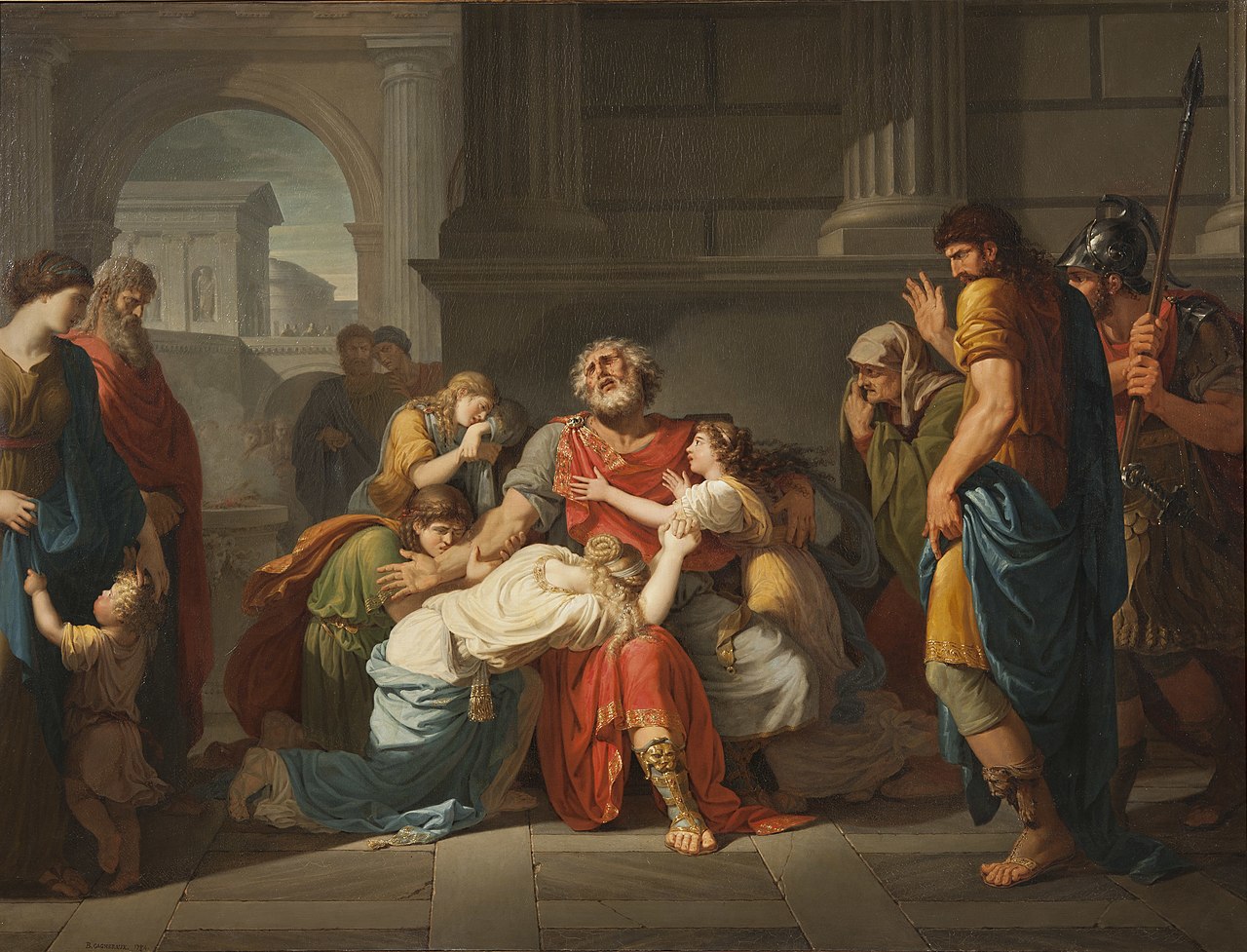 The Blind Oedipus Commending his Children to the Gods. Bénigne Gagneraux, Public domain, via Wikimedia Commons.
There is a term in literary criticism called anagnorisis, which refers to the moment in a story when a character (usually the protagonist) has an epiphany about their true situation, identity, conflict, or so on.
The placement or denial of this realization is one of the most powerful elements in drama. Take these examples:
Oedipus Rex, where the knowledge that Oedipus is destined to kill his father and marry his mother is revealed to the audience at the beginning, but not to Oedipus until the final scenes. This is the textbook example of dramatic irony: we the audience know something that the protagonist does not. The ultimate revelation is horrifying and painful.
Romeo and Juliet, where a miscommunication in the final act causes Romeo to believe that Juliet has committed suicide; he takes his life in despair, only for Juliet to wake up, realize what has happened, and commit suicide as well. Similarly, the lovers’ families, the Montagues and Capulets, do not understand the pain that their blood feud has inflicted on their own children until it is too late.
Frankenstein, where Dr. Victor Frankenstein reviles his own creation as a monster; but when the monster finally speaks, it is revealed to us as a soulful, gentle, empathetic creature who asks only for a wife. But Victor Frankenstein is too stubborn and shallow to see the wretch as anything but a monster, and vows to destroy it; their ensuing conflict ultimately costs him his family, his wife, his best friend, his sanity, and his life. Only in the final pages does the wretch realize how pointless and destructive their conflict was, and mourns Frankenstein before vowing to take its own life at the North Pole.
In each case, the tension between the audience’s knowledge and the characters’ hangs over the entire story; our inability to enter the story, even for a moment, and share our crucial knowledge can be almost excruciating. The underlying tragedy is that anagnorisis is denied or delayed until it is too late; if only they had known sooner, they could have avoided so much suffering. One of the central themes in George Orwell’s Nineteen Eighty-Four is that the protagonist, Winston Smith, is denied an understanding of the world around him: he’s unable to finish Emanuel Goldstein’s book explaining the world order imposed by Oceania, Eastasia, and Eurasia before being captured and brainwashed by the Thought Police. Orwell’s point is that oppressive and injust social systems are cruel partly because they deny their residents this deeper understanding.
Naturally, there are many stories where the protagonist achieves anagnorisis *before* tragedy strikes: consider The Truman Show, which follows a man named Truman Burbank who unknowingly lives his entire life on a soundstage controlled by a reality television show director. Not only do we the audience understand that Truman’s life is an illusion, but that the controlled nature of his life is the source of his suffering. When Truman discovers that he is living in a reality television show, he is able to escape. Not only does this resolve his suffering; it places him in control of his own destiny.
Critical Consciousness
 Prometheus Brings Fire To Mankind. Heinrich Füger, Public domain, via Wikimedia Commons
Anagnorisis is the term we use for literary characters. For us, living in real life, the term is sometimes called critical consciousness: it is the moment in our lives where revelation strikes, and questions we’ve had all our lives — whether we knew we had them or not — are answered, and we feel that we finally understand the world around us and our place within it.
People achieve critical consciousness in many different ways: perhaps they discover that they believe in God, or that they don’t, or that they are transgender or gay, or that their parents abused them, or that they are the beneficiary or the victim or racism or sexism, that their economic situation is unfair, that they have a disability, and so on.
This revelation is both deeply personal and intrinsically connected to the rest of society. For one example, many transgender people, especially older ones, may not have even known that transgenderism existed, which is an obvious prerequisite to understanding that it applies to them; this lack of knowledge is “present” in the entire culture and social zeitgeist. For another example, many survivors of child abuse are abused because parents are given such extensive legal control over their child’s life, and many schools are discouraged (if not outright forbidden) from teaching children to question their parents’ authority, worldview, or behavior. If, when, how, and where this knowledge becomes available depends on their environment.
Consider the case of Jennette McCurdy, whose memoir I’m Glad My Mom Died details her relationship with her abusive and controlling mother and untreated obsessive-compulsive disorder. Her mother’s behavior was enabled, if not rewarded, by the entertainment industry and cultural expectations around a parent’s control over their child; her Mormon background primed her to misinterpret her obsessive-compulsive disorder as directives from God. It took years before anyone gave her the information to consider that her mother was abusive, that she was suffering from a disability, and that the entertainment industry was complicit.
Hermeneutical Injustice
 The Blind Leading The Blind. Pieter Brueghel the Elder, Public domain, via Wikimedia Commons
The denial of this information is often called hermeneutical injustice, which refers to how shared knowledge and cultural norms put some people at an inherent disadvantage in understanding their own life and social experiences. The lack of this critical information denies us the tools to make sense of our lives; it is naturally denied most often to disadvantaged groups like transgender or gay people, children, disempowered racial and ethnic groups, and women.
But in an even greater sense, it is denied to all of us. All of our lives have been shaped by millennia of history, politics, and economics. One of the greatest passages I have ever read lays out the subject:
Nowadays people often feel that their private lives are a series of traps. They sense that within their everyday worlds, they cannot overcome their troubles, and in this feeling, they are often quite correct. What ordinary people are directly aware of and what they try to do are bounded by the private orbits in which they live; their visions and their powers are limited to the close-up scenes of job, family, neighborhood; in other milieux, they move vicariously and remain spectators. And the more aware they become, however vaguely, of ambitions and of threats which transcend their immediate locales, the more trapped they seem to feel.
Underlying this sense of being trapped are seemingly impersonal changes in the very structure of continent-wide societies. The facts of contemporary history are also facts about the success and the failure of individual men and women. When a society is industrialized, a peasant becomes a worker; a feudal lord is liquidated or becomes a businessman. When classes rise or fall, a person is employed or unemployed; when the rate of investment goes up or down, a person takes new heart or goes broke. When wars happen, an insurance salesperson becomes a rocket launcher; a store clerk, a radar operator; a wife or husband lives alone; a child grows up without a parent. Neither the life of an individual nor the history of a society can be understood without understanding both.
The rest of the text elaborates on the key to understanding both of these things. This is called the sociological imagination.
The Sociological Imagination
 A coloring of the Flammarion engraving. Unknown + Heikenwaelder Hugo, CC BY-SA 2.5 https://creativecommons.org/licenses/by-sa/2.5, via Wikimedia Commons
The text that I quoted from is the first two paragraphs of C. Wright Mills’s 1959 book, naturally titled The Sociological Imagination. The sociological imagination, as best as I can describe it, is the understanding of the connection between the lives of individuals and the lives of societies in their economic, historical, political, and social totality. As Mills describes, our individual lives are puppeteered by social and historical forces that are much larger than any single one of us, the same way that the life of an ant is determined by the climate of the entire planet. Only when we recognize and begin to understand these forces can we properly understand our own lives and try to change its course.
This is why I have always found sociology more rewarding to study than philosophy, which is unfortunate because the common perception is that philosophy (if not religion) is the one-stop shop for asking and answering the “truly profound” questions. Philosophy (at least as it’s practiced in the United States in the 21st century) seems to be concerned with answering mostly abstract questions independent of what is or is not the case here in the real world. This is the heart of Hume’s is-ought distinction: what we ought to do, believe, etc. must be independent of what is.
But sociology acknowledges that the questions that we have — more than that, the questions that we are even capable of inventing and articulating in the first place — are conditioned on the world around us, the knowledge that we are provided, and the circumstances in which we live. It is just as silly to expect someone living in Europe in the 1500s to ask serious questions about imperialism as it is to expect them to ask questions about general relativity; the terms imperialism and general relativity did not even exist yet.
Possessing the sociological imagination does not mean that we have all the answers; it doesn’t even necessarily mean we have the right questions. It just means that we have broken through and can take the first steps towards a complete understanding, and that the questions we ask now are much more likely to lead to the right questions, and finally to the right answers. Asking these questions allow us to push at the boundaries of culture and politics; they are how we create the knowledge that resolves hermeneutical injustice. To return to Mills,
The first fruit of this imagination—and the first lesson of the social science that embodies it—is the idea that the individual can understand his own experience and gauge his own fate only by locating himself within his period, that he can know his own chances in life only by becoming aware of those of all individual in his circumstances. In many ways it is a terrible lesson; in many ways a magnificent one. We do not know the limits of man’s capacities for supreme effort or willing degradation, for agony or glee, for pleasurable brutality or the sweetness of reason. But in our time we have come to know that the limits of ‘human nature’ are frighteningly broad. We have come to know that every individual lives, from one generation to the next, in some society; that he lives out a biography, and that he lives it out within some historical sequence. By the fact of his living he contributes, however minutely, to the shaping of this society and to the course of its history, even as he is made by society and by its historical push and shove.
The first questions we ask are about the time and place that we live in; what shaped it, where we come from, and what historical forces move over our lives. These forces constitute a hyperobject: something so vast and complicated, spanning time and space so vastly, that it is impossible for any one person to properly grasp.
Of course, the point is not to understand the entirety of human history. The point is to understand our own lives as best we can.
 Wanderer Above the Sea of Fog. Caspar David Friedrich, Public domain, via Wikimedia Commons